

Merck Animal Health
Panacur Equine Dewormer Paste
Panacur Equine Dewormer Paste
Couldn't load pickup availability
Panacur Equine Dewormer paste is indicated for the control of large strongyles (Strongylus edentatus, S. equinus, S. vulgaris), encysted early 3rd stage (hypobiotic), late 3rd stage and 4th stage cyathostome larvae, small strongyles, pinworms (Oxyuris equi), ascarids (Parascaris equorum), and arteritis caused by hypobiotic larvae of Strongylus vulgaris in horses. Safe for foals and pregnant mares, older horses, thin and underweight horses, miniature horses, the environment, and for use around other farm animals and pets
Contains 100 mg fenbendazole per gm.
Each 25-gm syringe treats up to 1,100 lbs. For foals and weanlings less than 18 months of age, use double the dose on a per pound basis.
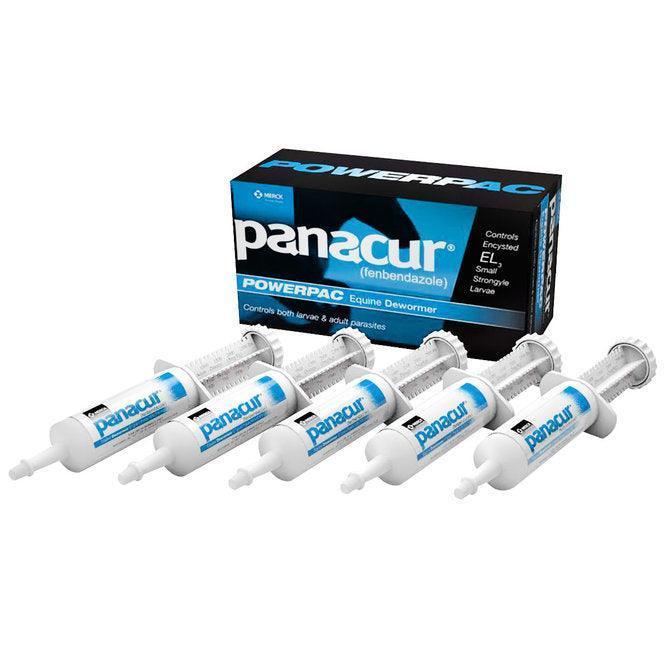
For control of encysted early 3rd stage, late 3rd stage and 4th stage small strongyle larvae, and 4th stage large strongyle larvae, use the Panacur PowerPac. PowerPac is the only FDA-approved treatment for all stages of encysted small strongyles. PowerPac contains five 57 gm syringes, 1 each for 5 consecutive days of treatment for a 1,250 lb horse.
Provides a unique mode of action - the antiparasitic action of Panacur is due to the inhibition of energy metabolism in the parasite.
Panacur Equine Dewormer Paste Features & Benefits
- Proven safe
- Works on a wide variety of parasites
- Effective on encysted small strongyles
- Easy to administer
- Unique mode of action
25 gm Dosage:
For foals and weanlings (less than 18 months of age) where ascarids are a common problem, the recommended dose is 4.6 mg/lb (10 mg/kg); one syringe will deworm a 550 lb horse.
For the control of large strongyles, small strongyles, and pinworms, the recommended dose is 2.3 mg/lb (5 mg/kg). One syringe will deworm a 1,100 lb horse.
For control of hypobiotic (encysted early 3rd stage), late 3rd stage, and 4th stage cyathostome larvae, as well as 4th stage Strongylus vulgaris larvae, the recommended dose is 4.6 mg/lb (10 mg/kg) daily for 5 consecutive days; administer one syringe for each 550 lb body weight per day.
57 gm Dosage:
Panacur® Paste 10% is administered orally at a rate of 2.3 mg/lb (5 mg/ kg) for the control of large strongyles, small strongyles, and pinworms. One syringe will deworm two 1,250 lb (568 kg) horses at a dose of 5 mg/kg. For foals and weanlings (less than 18 months of age) where ascarids are a common problem, the recommended dose is 4.6 mg/lb (10 mg/kg); one syringe will deworm a 1,250 lb horse.
For control of hypobiotic (encysted early 3rd stage), late 3rd stage, and 4th stage cyathostome larvae, as well as 4th stage Strongylus vulgaris larvae, the recommended dose is 4.6 mg/lb (10 mg/kg) daily for 5 consecutive days; administer one syringe for each 1,250 lb body weight per day.
Do not underdose. Ensure each animal receives a complete dose based on a current body weight.
Underdosing may result in ineffective treatment, and encourage the development of parasite resistance.
PRECAUTIONS:
Side effects associated with Panacur® Paste 10% could not be established in well-controlled safety studies in horses with single doses as high as 454 mg/lb (1,000 mg/kg) and 15 consecutive daily doses of 22.7 mg/lb (50 mg/kg). Particularly with higher doses, the lethal action of fenbendazole may cause the release of antigens by the dying parasites. This phenomenon may result in either a local or systemic hypersensitivity reaction. As with any drug, these reactions should be treated symptomatically.
Panacur® Paste 10% has been evaluated for safety in pregnant mares during all stages of gestation with doses as high as 11.4 mg/lb (25 mg/kg) and in stallions with doses as high as 11.4 mg/lb (25 mg/kg). No adverse effects on reproduction were detected. The recommended dose for control of 4th stage Strongylus vulgaris larvae, 4.6 mg/lb (10 mg/kg) daily for 5 consecutive days, has not been evaluated for safety in stallions or pregnant mares.
WARNINGS: NOT FOR USE IN HUMANS. KEEP OUT OF REACH OF CHILDREN. The Safety Data Sheet (SDS) contains more detailed occupational safety information. For customer service, adverse effects reporting, and/or a copy of the SDS, call 1-800-211-3573. For additional information about adverse drug experience reporting for animal drugs, contact FDA at 1-888-FDAVETS, or http://www.fda.gov/reportanimalae.
OTHER WARNINGS: Do not use in horses intended for human consumption.
Parasite resistance may develop to any dewormer and has been reported for most classes of dewormers. Treatment with a dewormer used in conjunction with parasite management practices appropriate to the geographic area and the animal(s) to be treated may slow the development of parasite resistance. Fecal examinations or other diagnostic tests and parasite management history should be used to determine if the product is appropriate for the herd, prior to the use of any dewormer. Following the use of any dewormer, effectiveness of treatment should be monitored (for example, with the use of a fecal egg count reduction test or another appropriate method). A decrease in a drug’s effectiveness over time as calculated by fecal egg count reduction tests may indicate the development of resistance to the dewormer administered. Your parasite management plan should be adjusted accordingly based on regular monitoring.
This item cannot be shipped to California.
Manufacturer and/or Label Information
Manufacturer and/or Label Information
Dimensions
Dimensions
Care information
Care information
Let customers speak for us
Best pricing

4" Brim, Medium Crown, Guatemalan Standard Palm Hat

It helps with the itching but my horse itches all over from an allergy, I can't afford that much Killitch

Easy peasy. Ordered and delivered no problems!

I recently bought a River Gambler Palm hat from them and I'm loving it!
I found no issues with the seller's communication or the delivery of my purchase!
I strongly recommend this business

High quality and comfort. Good price.

Master Guard 10 HB

Fusogard

This is a great choice if you have an animal that does not like loud noise!

The new Crown Cap is awesome. It isn’t quite as heavy fabric as his old one but he actually likes it better so it’s a win, win. Highly recommend and the service was great. Thank you.

If you have ever tried to loosen or tightened a Chicago screw they can be a pain.This tool is great.The people at Houlihan were fast in midst of holiday season.Buy from them you will never regret it

Ivermectin Pour-On Applicator (70 mL)

Great for horses that are nervous or tight in their atlas TMJ area.

Hock Lock Spare Rings-Set of 3

My grandson was happy to receive the plaid check stockman cap. It arrived just in time for Christmas.
Thank you,
Debbie