

Durvet
Horse to Foal 2X Dewormer
Horse to Foal 2X Dewormer
Couldn't load pickup availability
Horse to Foal 2X Dewormer Features and Benefits
- Apple flavored
- Easy to feed pellet form
- Simple one-day treatment
- Each bag treats up to 2,000 lbs. of body weight
- Bag Size: 1 b
Directions:
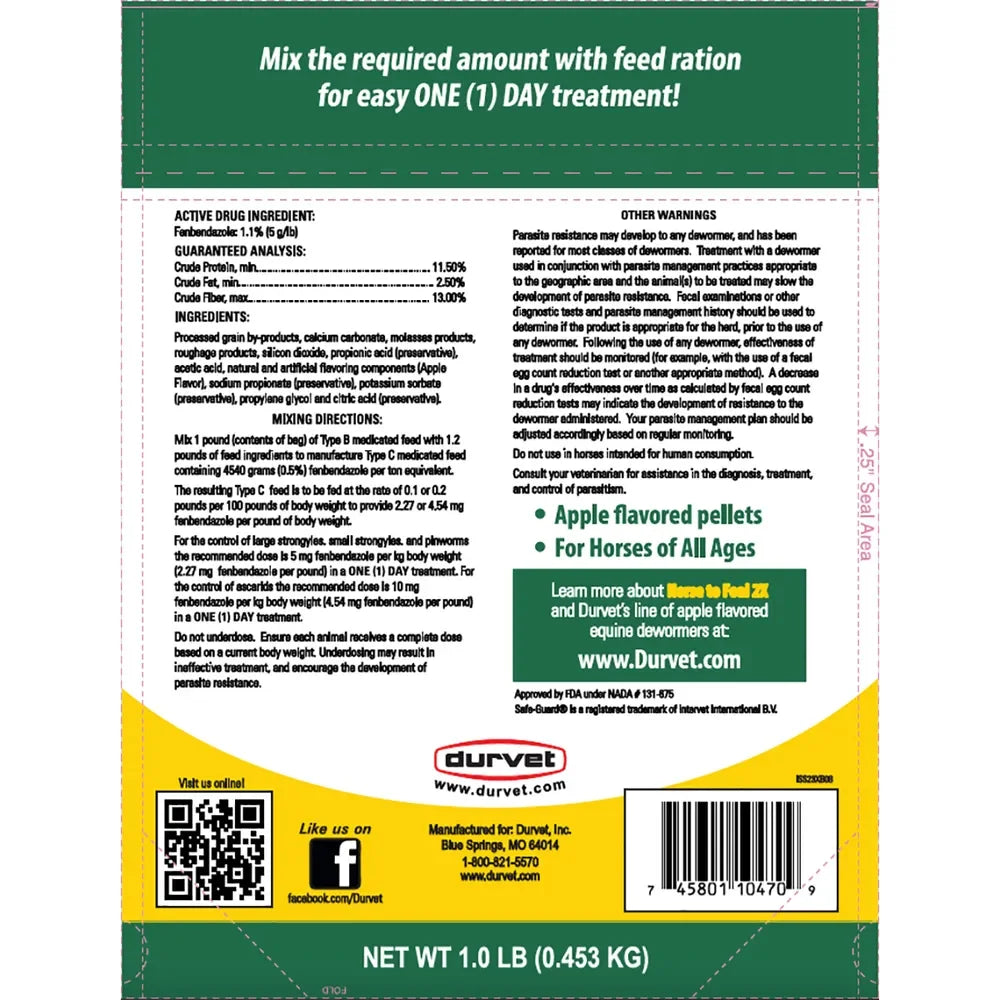
- Mix 1 pound (contents of bag) of Horse to Foal 2X Dewormer medicated feed with 1.2 pounds of feed ingredients to manufacture Type C medicated feed containing 4540 grams (0.5%) fenbendazole per ton equivalent.
- The resulting Type C feed is to be fed at the rate of 0.1 or 0.2 pounds per 100 pounds of body weight to provide 2.27 or 4.54 mg fenbendazole per pound of body weight.
- For the control of large strongyles, small strongyles, and pinworms the recommended dose is 5 mg fenbendazole per kg body weight (2.27 mg fenbendazole per pound) in a ONE (1) DAY treatment. For the control of ascarids the recommended dose is 10 mg fenbendazole per kg body weight (4.54 mg fenbendazole per pound) in a ONE (1) DAY treatment.
Do not underdose. Ensure each animal receives a complete dose based on a current body weight. Underdosing may result in ineffective treatment, and encourage the development of parasite resistance.
Guaranteed Analysis:
|
Crude Protein, min |
11.50% |
|
Crude Fat, min |
2.50% |
|
Crude Fiber, max |
13.00% |
Active Drug Ingredient:
Fenbendazole: 1.1% (5 g/lb)
Ingredients:
Processed grain by-products, calcium carbonate, molasses products, roughage products, silicon dioxide, propionic acid (preservative), acetic acid, natural and artificial flavoring components (Apple Flavor), sodium propionate (preservative), potassium sorbate (preservative). propylene glycol and citric acid (preservative)
Warning:
Parasite resistance may develop to any dewormer, and has been reported for most classes of dewormers. Treatment with a dewormer used in conjunction with parasite management practices appropriate to the geographic area and the animal(s) to be treated may slow the development of parasite resistance. Fecal examinations or other diagnostic tests and parasite management history should be used to determine if the product is appropriate for the herd, prior to the use of any dewormer. Following the use of any dewormer. effectiveness of treatment should be monitored (for example, with the use of a fecal egg count reduction test or another appropriate method). A decrease in a drug’s effectiveness over time as calculated by fecal egg count reduction tests may indicate the development of resistance to the dewormer administered. Your parasite management plan should be adjusted accordingly based on regular monitoring.
Do not use in horses intended for human consumption.
Consult your veterinarian for assistance in the diagnosis, treatment, and control of parasitism.
Manufacturer and/or Label Information
Manufacturer and/or Label Information
Let customers speak for us
River Gambler hat

In a world where everything is getting lower in quality, this place was great.

Best pricing

4" Brim, Medium Crown, Guatemalan Standard Palm Hat

It helps with the itching but my horse itches all over from an allergy, I can't afford that much Killitch

Easy peasy. Ordered and delivered no problems!

I recently bought a River Gambler Palm hat from them and I'm loving it!
I found no issues with the seller's communication or the delivery of my purchase!
I strongly recommend this business
High quality and comfort. Good price.

Master Guard 10 HB

Fusogard

This is a great choice if you have an animal that does not like loud noise!

The new Crown Cap is awesome. It isn’t quite as heavy fabric as his old one but he actually likes it better so it’s a win, win. Highly recommend and the service was great. Thank you.

If you have ever tried to loosen or tightened a Chicago screw they can be a pain.This tool is great.The people at Houlihan were fast in midst of holiday season.Buy from them you will never regret it

Ivermectin Pour-On Applicator (70 mL)

Great for horses that are nervous or tight in their atlas TMJ area.